


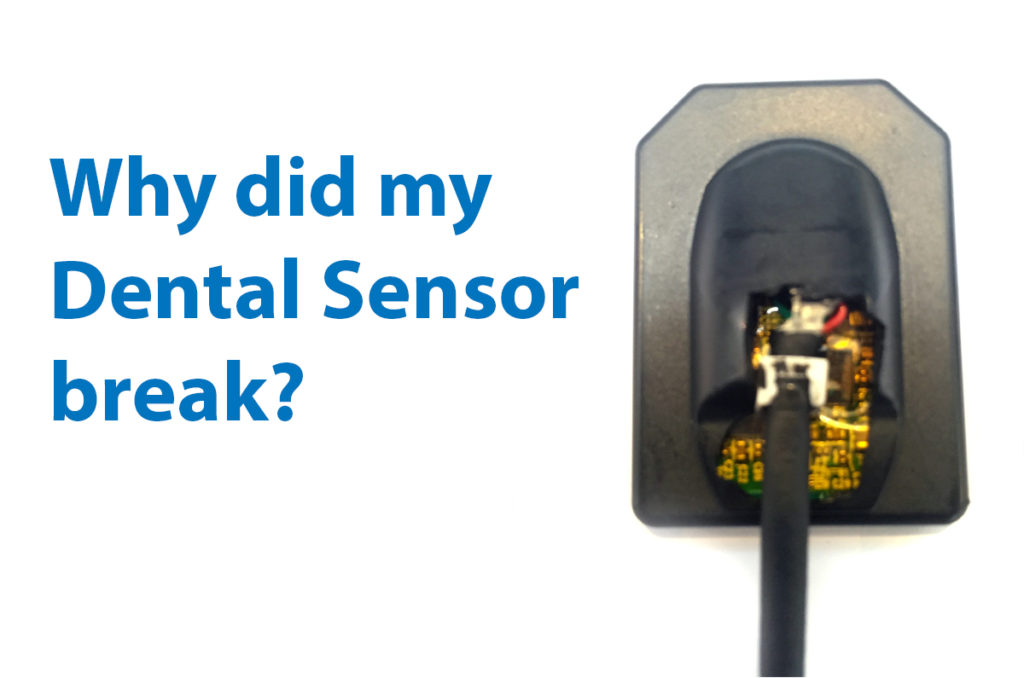
The Top Reasons for Dental Sensor Failure
I figured I would try to clear some things up and make doctors aware on why their sensor may have failed and how it could have been prevented.
Now the average life span of a sensor is about 5 years. Can a dental sensor last longer than that? With the proper care absolutely!
Cable Failure
Probably the number one failure point of a sensor is the cable. Why is this? Depending on your sensor you can have anywhere from 4 to 16 wires in your cable. Now every sensor manufacture has different gauges of those wires. Some thicker or thinner than others. The less wires you have in the cable typically the manufacture will do a larger gauge wire.
Even if you have a larger gauge that still does not make the sensor cable indestructible. It just helps increase the life of the cable.
Think of those wires in your sensor cable a lot like a wire coat hanger. If you bend a coat hanger enough times eventually it will break. That is just the nature of the beast. Now your wires in your cable are significantly smaller than a coat hanger. A typical dental sensor in an office can bend nearly 12,000 times a year. Eventually just like the coat hanger the wires in the cable will eventually split from each other.
What we have done with the Ei Dental Sensor and other manufactures have done as well is to increase the gauge of the wire as well as wrap the wires in a Kevlar wrapping to help protect them even further.
Now a common misconception is that this bending of the wire is a Manufacture Defect and should be fixed under the Manufactures Warranty. This just simply not the case. Yes, the cable is able to bend within reason. But, inherently the cable will fail in all sensors eventually. Now, you can prolong this failure by proper sensor care.
Here some common Do’s and Don’t to make sure you cable last as long a possible.
- DO uncoil the sensor gently
- DO carefully remover tangles and sharp bends while uncoiling cable
- DO hold onto the sensor body while removing any tabs, holders, or sheaths, Be as gentle as possible.
- DON’T allow your patients to bite on the cable. (Greatest factor in cable failure)
- DON’T clamp the cable with a hemostat or equivalent
- DON’T pull on the sensor by its cable during sheath removal
- DON’T hang sensor by its cable
- DON’T let the cable hang on or near the floor where it can become tangled or rolled over with chair
- DON’T let the cable hang near a drawer where it can be kinked/crimped
- DON’T pull on the cable to remove from tab, holder, or sheath
- DON’T tangle cable during use
- DON’T create sharp bends and/or knots when untangling
Now some manufactures have cable replacements. The Ei Dental Sensors can do a cable replacement for about $900, which sure beats having to buy a new sensor at retail. A lot of the major manufactures will tell you if you break the cable you need to buy a new sensor. I said before this is typically not a Manufactures Defect.
Now the Schick 33 digital sensor has a modular design and has a cable that can come off of the dental sensor. There is some advantages and disadvantages to this.
The advantage to this is the doctor can buy extra cables for his sensor even at various lengths. The doctor can then replace the cable themselves and be up and running in just a few minutes.
The downsides to this design, for one it is not a sealed designed and is not waterproof. This design is also prone to failure and corrosion. Corrosion, can mess with the sensors voltage thus cause intermittent connections issues with the sensor. The other down side is the price. They are still pretty expensive for a replacement cable I have heard upwards of $1,500. (If you got a quote for cheaper let me know). So this cable design sounds good in theory but tends to cause more issues then what it’s worth.
Like I said earlier with the Ei Dental Sensor we can replace the cable on our sensor. It needs to be sent to the manufacture they will crack the case open, put a new cable on and put it all back together and reseal it.
Sensor Housing
The next spot for sensor failure is the sensor itself and the housing. One of the most common reasons for failure here is too much force put on the sensor, now this can be many things. The dental sensor could have been dropped, stepped on, bitten on, crushed, etc.
Now most dental sensors on the market are fairly durable to these types of things. Consider your sensor a lot like your cell phone. You can probably drop your cell phone on concrete and it not break. Same goes with a sensor. But, it only takes once for it to break.
A common thing to happen when your sensor is dropped is what they call delamination. If this happens you will typically have a big dark spot in your x-ray typically where the impact point was. Delamination only happens from excessive force to the sensor.
These types of damages are also not covered under manufactures warranty. It truly blows me away how many doctors think this would be. To me it is a lot like buying a car and getting in an accident right off the lot and expecting the dealership to replace your car for free. It is just not going to happen.
Now most sensor manufactures do have an Accidental Coverage warranty in the event that this does happen.
Now the types of plans can vary. For example, Dexis has a couple different plans. That range from $1500-$2000 year. The big difference is the accidental coverage. You typically get a percentage discount off of the retail price of the sensor if it breaks.
Other companies have a 5 Year Protection plan that ranges from a one-time fee of $495 – $695 per sensor. And if you break your sensor it is either 50% off or it is a pro-rated replacement cost that grows over the 5 years. After the five years, if you break your sensor. You are going to have to buy a new one at full retail.
With the Ei Dental Sensors, we offer our SensorCare Protection Plan it is $495/year and covers up to (10) sensors per office. So if you bought, say one sensor now and another two years from now, the new sensor would automatically enrolled in the SensorCare Plan. If you break your sensor and you are enrolled in the SensorCare Plan, we will give you 2 quotes. One quote would be for getting your current broken sensor fixed by the manufacture and the second quote would be for 50% off the current retail prices and you would get a brand new sensor. Not a refurbished one like some manufactures do. If you really damaged the sensor and the cost to get it fixed is more than the replacement then obviously it would make sense to get the new replacement sensor at 50% off. We will also overnight you a loaner sensor or new replacement sensor depending on the quote you choose. This way you are up and running as soon as possible.
Now there are some things you can do to help protect you Sensor/Housing as well. Here is some Dos and Don’ts:
- DO wipe down the sensor with a sterile solution (Alcohol-Free Wipe Only e.g Optim 33TB or Sporicidin)
- DO store the sensor in its protective case or Storage Wall Mount when it is not in use
- DO keep the sensor off of the floor at all times
- DO use proper bite holders, tabs and sterile sheaths every time the sensor is used
- DO ground yourself from any static electricity before handle your sensor
- DON’T autoclave the sensor
- DON’T expose the sensor’s USB connector to any liquids
- DON’T clamp the sensor or its cable with a hemostat or equivalent
- DON’T pull the sensor by its cable during sheath removal
- DON’T hang the sensor by its cable
- DON’T allow anyone to bite on the sensor
- DON’T store sensor in direct sunlight
Sensor Care Tips
There are some other things you can do as well to help prolong the life of your sensor. The first would be to get a usb extension and put it on the end of your sensor. You can get a long one but you don’t want to go to long, as you will run in to power issues as USB can only be stretched so far. Best to stay 6 feet or under on an extension.
The purpose of the extension is when you plug you sensor in to your USB port on your computer you will start to wear out the USB end of your sensor as well as your port in your computer. With the USB extension you will be wearing out the extensions end and not your sensor USB end. It’s a heck of a lot cheaper to replace a $3 USB extension then to get a $900 + cable replacement
Another thing you should add as well, is a powered USB Hub. The Powered USB hub serves a couple different purposes. For one you need to make sure the hub has its own power source and is not getting its power from your computer. You will know this if when you got your hub, you plugged a USB cable from the hub to your computer and a power cable from the hub to a wall outlet (preferably a surge protector).
Sensors are really power hungry they need every ounce of power for them to work properly. Without enough power you can run in to a slew of different issues. A lot of times the ports in your computer are not meeting the specs in the power they should be receiving. The reason for this can be a number of things ranging from the Manufacture who made the computer, the model of it to the computer is just old and worn out.
I have seen Sensors that were not getting enough power just not be recognized by the computer at all and even mess with the x-ray taken from the sensor. The powered usb hub will insure your sensor is getting all the power it needs. It also is protecting your computers USB ports because you are now wearing out the hubs ports and not your computers ports. Again, it’s a lot easier and cheaper to replace a powered usb hub then the ports in your computer.
With the Ei Dental Sensors. We not only provide a powered USB hub for every sensor your buy, but also include a 360 swivel USB adapter for your sensor protecting both your sensor, cable and computer ports.
So in a nut shell if you want your sensor to last:
- Get a Powered USB Hub
- Get a USB extension or Swivel adapter
- Don’t let your patients bite on your sensor or cable…..PERIOD!!!!…In fact stop using the word “BITE”
- Handle the sensor with care and try not to drop the sensor
- Don’t tangle the cable on your sensor
- Clean sensor with non-alcohol based disinfectants
- Make sure your ENTIRE staff knows how to properly care for your sensor and hold them accountable for it
- Get a protection plan for your sensor. You don’t know what the future holds. It only takes once to break it.
- Don’t have a sensor yet? Look for a sensor that is affordable as well as has a great protection plan and is affordable.
If anyone has any questions on how to further protect their sensors or are looking to get an affordable sensor with a great protection plan. Feel free to give us a call at (800) 869-0915 or find more information at DentalSensors.com